Why Solid-State Batteries Degrade Quickly and How Innovations Are Addressing This: DallasFixTech’s Insights in Dallas, TX
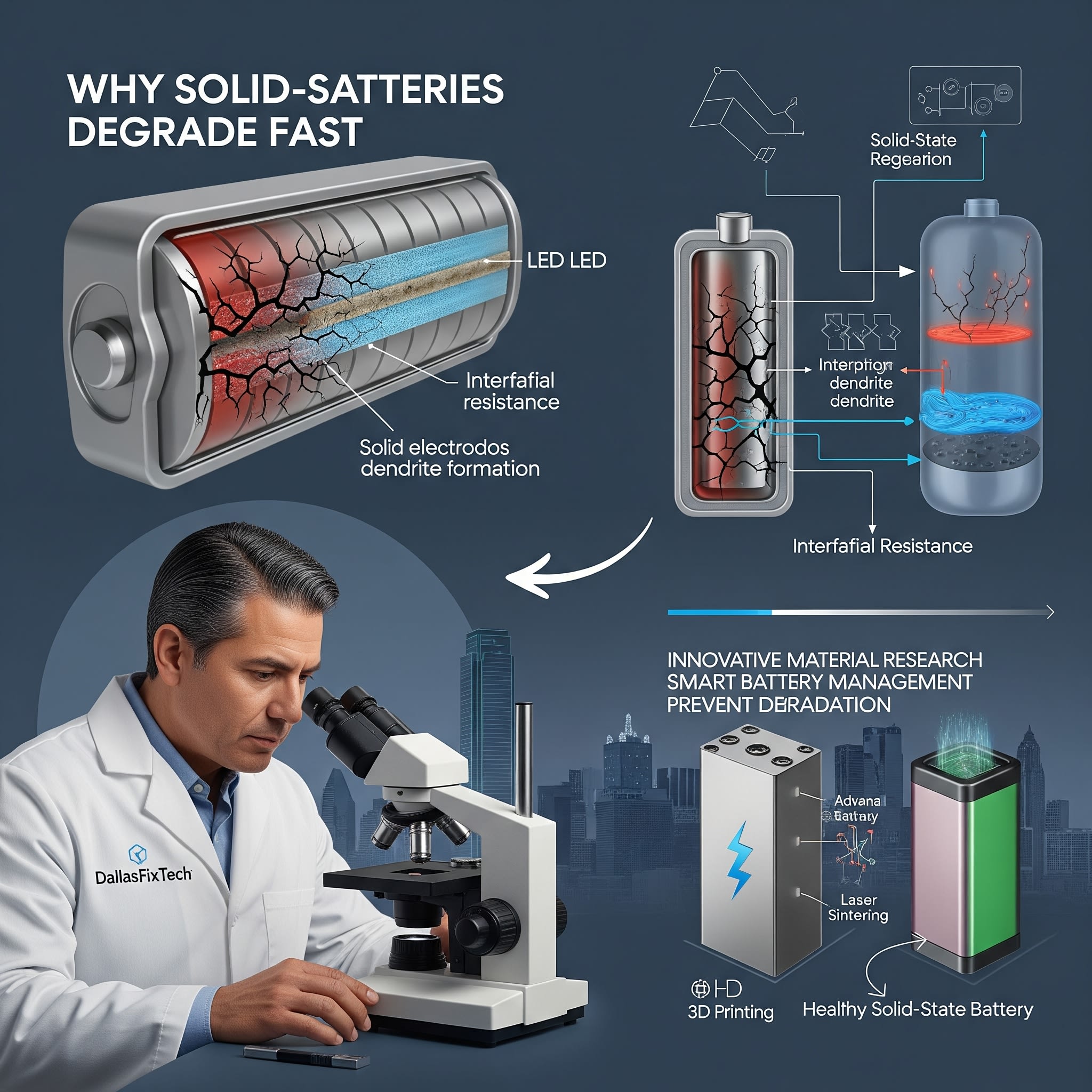
**Solid-state batteries** are often hailed as the 'holy grail' of battery technology, promising revolutionary advancements over traditional lithium-ion batteries. With potential benefits like significantly higher energy density (longer range for EVs), enhanced safety (non-flammable solid electrolytes), and faster charging, they are poised to transform electric vehicles, portable electronics, and grid storage. However, despite intense research and promising lab results, one of the primary hurdles delaying their widespread commercialization is their **tendency to degrade rapidly**, leading to shorter lifespans than expected. At **DallasFixTech** in Dallas, TX, we closely follow cutting-edge energy tech. We explain the current challenges behind the rapid degradation of solid-state batteries, focusing on issues like **interface instability and dendrite growth**, and highlight emerging solutions in material science and engineering that are helping to improve their longevity and commercial viability.
Key Causes of Rapid Degradation in Solid-State Batteries (DallasFixTech Analysis)
The core challenges often lie at the interfaces within the battery cells:
- Interface Instability Between Solid Electrolyte and Electrodes: This is a major hurdle. Unlike liquid electrolytes that maintain excellent contact, the solid electrolyte's interface with the electrodes (anode and cathode) can be unstable. Repeated charging and discharging cycles can cause these interfaces to lose contact, increase resistance, and create voids, leading to capacity loss.
- Dendrite Formation Causing Short Circuits: Similar to traditional lithium-ion batteries, but potentially more severe, lithium dendrites (tree-like metallic structures) can grow from the anode through the solid electrolyte during charging. These dendrites can puncture the solid electrolyte, leading to internal short circuits, rapid capacity loss, and safety issues.
- Thermal Stresses During Charge and Discharge Cycles: Despite being 'solid,' these batteries still generate heat. The differing thermal expansion coefficients of the various solid materials can create mechanical stresses during charge/discharge cycles, leading to cracks or delamination at interfaces.
- Ion Conductivity Issues: Some solid electrolytes have lower ion conductivity than liquid ones, especially at lower temperatures, leading to slower charging/discharging and increased internal resistance.
- Manufacturing Challenges: Creating perfect, uniform, and stable interfaces across large surface areas within a solid battery cell is extremely difficult at scale.
Emerging Solutions & Best Practices to Improve Longevity (DallasFixTech Insights)
Researchers are focusing on materials science and engineering innovations:
- Advanced Surface Coatings to Stabilize Interfaces: Developing ultra-thin, highly conductive, and stable coatings (e.g., polymer layers, ceramic interlayers) for the electrode-electrolyte interfaces. These coatings improve ion transfer and prevent direct contact that leads to instability and dendrite growth.
- Improved Solid Electrolyte Formulations: Researching new solid electrolyte materials (e.g., sulfides, oxides, polymer-based) with higher ionic conductivity, better mechanical properties (to resist dendrite penetration), and greater chemical stability.
- Optimized Thermal Management Systems: Designing battery packs with precise thermal management systems to maintain optimal operating temperatures, reducing thermal stresses and chemical degradation.
- Pressure Application: Applying external pressure to the solid-state battery stack can help maintain good contact between layers and suppress dendrite growth.
- New Anode/Cathode Materials: Developing compatible electrode materials that work seamlessly with solid electrolytes and resist degradation.
- Advanced Manufacturing Techniques: Innovating new manufacturing processes (e.g., dry coating, roll-to-roll manufacturing) to create perfect, uniform interfaces at scale.
Stay Ahead with Solid-State Battery Expertise in Dallas, TX!
Solid-state batteries hold immense potential, and overcoming degradation challenges is key to their future. **DallasFixTech** highlights advances in material coatings, interface engineering, and thermal management that are helping improve their longevity. **Contact DallasFixTech** today for insights, repairs, and support in solid-state battery systems, or for consultation on advanced energy tech in Dallas, TX. Stay ahead with solid-state battery expertise!


