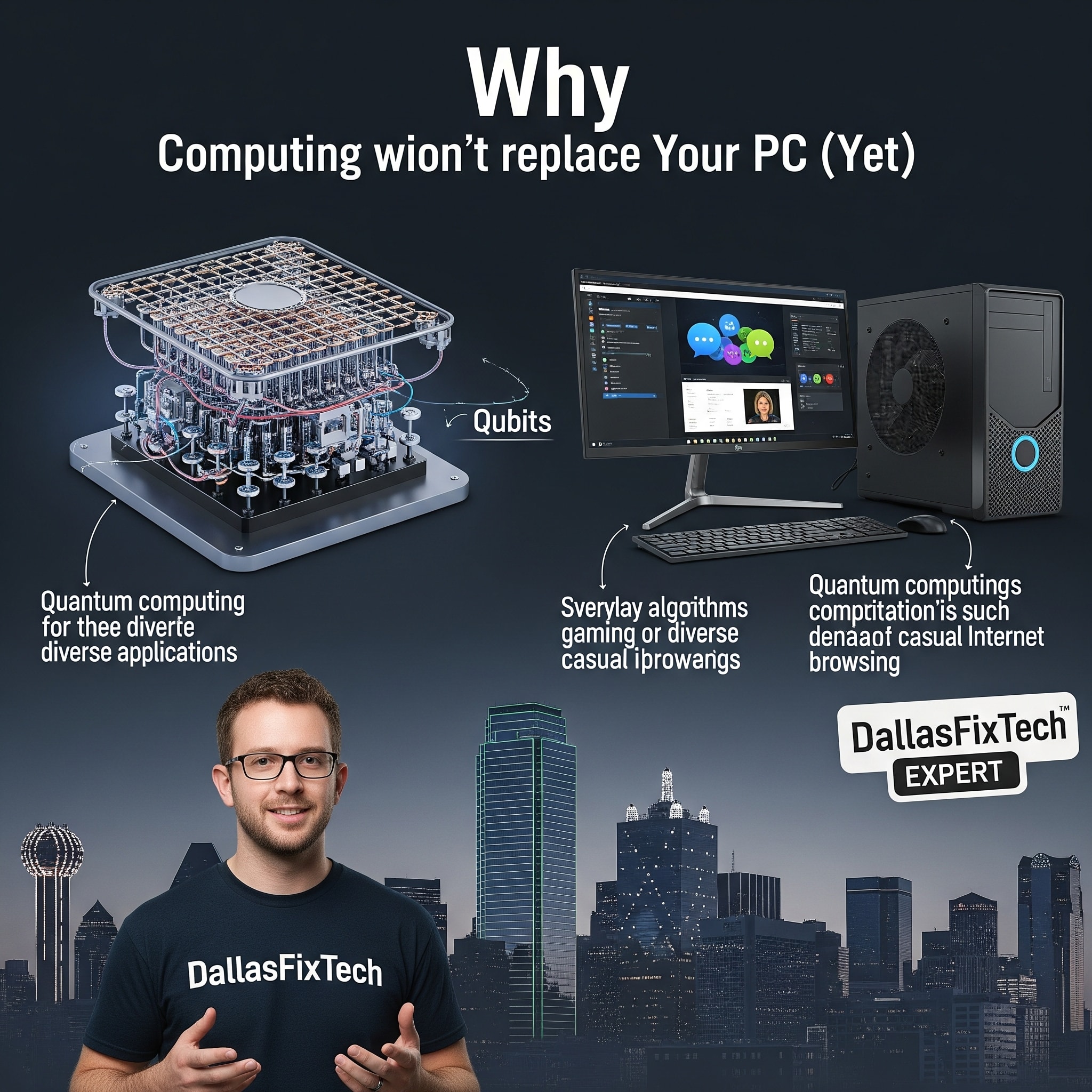
Why Quantum Computing Won’t Replace Your PC (Yet): DallasFixTech’s Insights for Dallas, TX
The field of **quantum computing** is one of the most exciting and talked-about frontiers in emerging technology. With its promise of solving problems impossible for even the most powerful supercomputers, it’s easy for imaginations to run wild and envision a future where 'quantum PCs' sit on every desk, rendering our current computers obsolete. However, despite the groundbreaking capabilities of quantum machines, it's crucial to understand their fundamental differences and current limitations. **DallasFixTech** clarifies why your classical personal computer will continue to dominate daily computing for Dallas, TX, users for the foreseeable future. Quantum computers are fundamentally different machines, optimized for highly specific, complex problems rather than general-purpose tasks. Let's delve into their current limitations and the realistic quantum future.
Understanding Quantum vs. Classical Computing (DallasFixTech Primer)
- Classical PCs: These are the computers we use every day. They store and process information as **bits**, which can be either a 0 or a 1. They excel at sequential processing and are perfect for tasks like Browse the web, word processing, gaming, video streaming, and most traditional scientific simulations.
- Quantum Computers: These machines leverage principles of quantum mechanics. They store information as **qubits**, which can be 0, 1, or both simultaneously (a state called **superposition**). This allows them to process vast amounts of information in parallel and explore many possibilities at once. They excel at specific types of problems that classical computers struggle with exponentially.
Current Limitations: Why Quantum Computing Won’t Replace Your PC (Yet)
Despite their immense power for specific tasks, significant hurdles prevent quantum computers from becoming everyday devices:
- Qubit Instability & Error Correction: Qubits are incredibly fragile and prone to 'decoherence'—losing their quantum state due to environmental interference (heat, vibrations, electromagnetic fields). Maintaining their quantum state requires extremely cold temperatures (colder than deep space) and massive, complex error correction mechanisms, making the hardware incredibly sensitive and prone to errors.
- Hardware Costs & Scale: Quantum machines are extraordinarily expensive to build, operate, and maintain, often requiring specialized laboratories and highly trained personnel. Their immense size and delicate nature make them utterly impractical for personal use.
- Limited Application Scope: This is a critical distinction. Quantum computers are not universally better at everything. They are best suited for specific, niche problems where their unique properties offer an exponential speedup. These include:
- **Drug Discovery & Materials Science:** Simulating complex molecular interactions for new pharmaceuticals or materials.
- **Cryptography:** Breaking certain types of current encryption algorithms (e.g., RSA) and creating new, quantum-resistant ones.
- **Financial Modeling:** Optimizing complex financial portfolios and risk analysis.
- **Logistics & Optimization:** Solving highly complex routing problems (e.g., supply chain optimization).
- **Artificial Intelligence/Machine Learning:** Accelerating specific AI algorithms.
- Programming Complexity: Programming quantum computers requires a fundamentally different approach and specialized algorithms (quantum algorithms) that are vastly more complex to design and implement than classical programming.
- Access & Usability: Currently, access to quantum computers is primarily through cloud services provided by tech giants (IBM, Google, Microsoft) to researchers and large corporations. They are not 'user-friendly' in the way a PC is.
The Realistic Quantum Future (DallasFixTech Outlook)
Instead of replacing your personal computer, quantum computing will likely function as a powerful, specialized **co-processor** for specific, intractable problems that classical computers cannot handle efficiently. You'll continue to use your classical PC for daily tasks, and when a problem arises that is 'quantum-suitable' (e.g., a complex drug simulation), your PC will send that specific computation to a quantum computer via the cloud. The quantum computer will process it, and the results will then be sent back to your PC. This 'hybrid' approach is the most likely near-to-mid-term future for leveraging quantum power.
Stay Informed with DallasFixTech’s Insights on Emerging Computing Tech!
While quantum computing is fascinating and holds immense promise for the future, your reliable PC isn't going anywhere for your daily needs. **DallasFixTech** clarifies why classical PCs continue to dominate daily computing for Dallas users. **Contact us** today for more insights into the realistic quantum future and other emerging computing technologies. Stay informed with DallasFixTech’s expert insights on technological advancements shaping tomorrow!


